
ISRAEL: A REVOLUTIONARY STEP TOWARD RESTORING THE SENSE OF TOUCH

Traumatic peripheral nerve injury (TPNI) is a common condition affecting approximately 2.8% of trauma patients and can lead to permanent disability, chronic pain, and a reduced quality of life.

A common effect of TPNI is the loss of tactile sensation, which not only interferes with patients’ daily lives but also increases their susceptibility to injury. At present, only a few solutions are available for restoring the sense of touch. The most commonly used therapy is surgical nerve reconstruction through nerve autografts or the implantation of nerve tissue taken from other donors. Unfortunately, nerve reconstruction can only be performed within a limited time window (the first two years after the injury) and requires healthy skin and viable nerve endings. Moreover, even when these conditions are met, the success rate is low.
A promising alternative pathway for restoring tactile sensation is the development of wearable or implantable neuroprosthetic devices that simulate the experience of touch. This simulation is achieved by translating pressure stimuli in the damaged area into electrical signals that can then be processed by the brain. In Israel, at the Technion – Israel Institute of Technology in Haifa, a team of researchers has developed a device that could revolutionise reconstructive medicine and human–machine interfaces: the Triboelectric Nano-Generator (TENG).
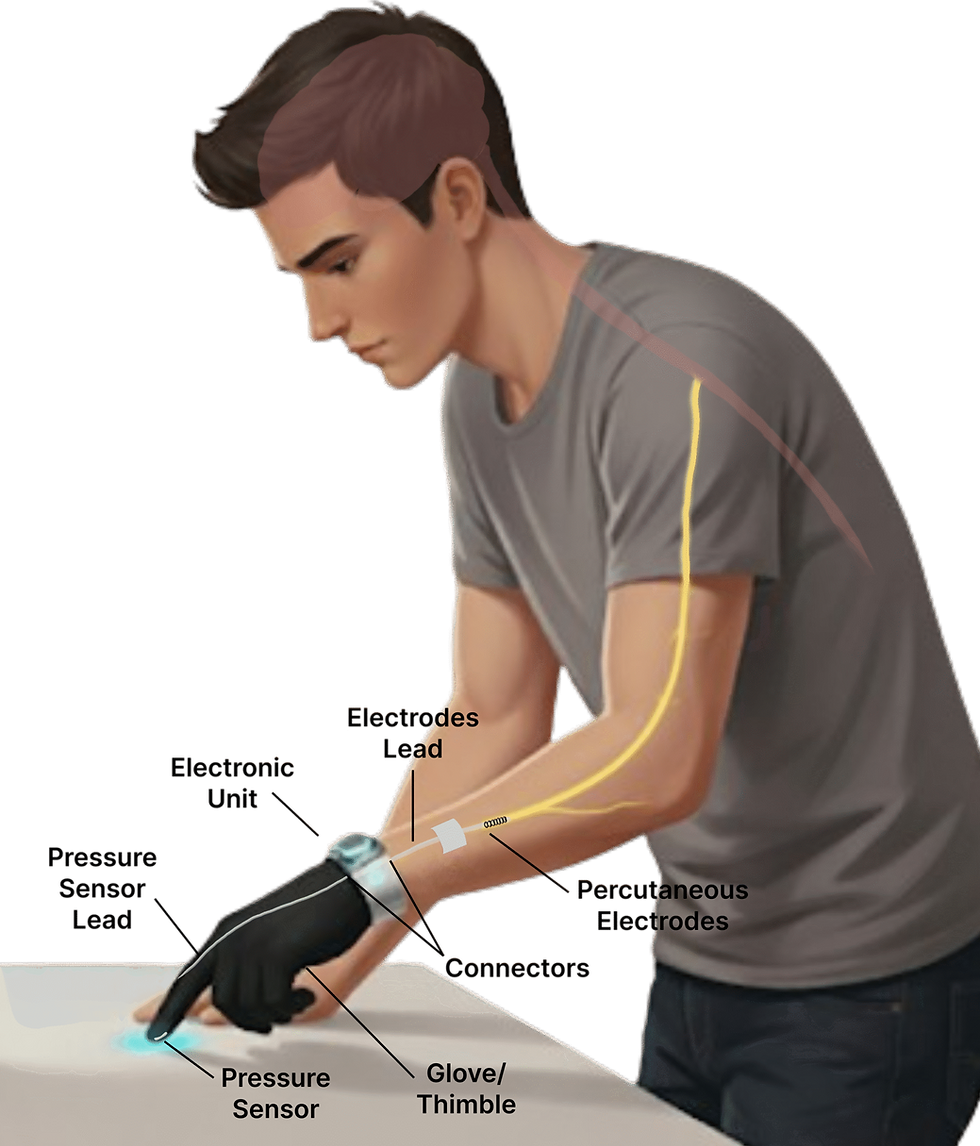
The TENG exploits the triboelectric effect: two thin layers of material, coming into and out of contact, generate electricity. The device is surgically implanted under the skin (for example, at the tip of an insensate finger) and then connected to a nearby healthy nerve. When pressure is applied—even minimal pressure—the device converts mechanical force into an electrical impulse that stimulates the nerve. The brain thus receives a signal corresponding to tactile sensation, restoring perceptions ranging from the lightness of a feather to the pressure of a handshake.
The implant requires less than an hour of surgery and does not need external batteries, as the device is self-powered by movement itself.
The potential of TENG extends beyond the restoration of touch. Thanks to its miniaturisation, flexibility and energy independence, this technology could be applied to:
tactile robotics,
human–machine interfaces,
implantable biomedical sensors,
smart fabrics and devices,
autonomous environmental sensory networks.
The triboelectric nano-generator TENG, born from Israeli research at the Technion in Haifa, represents a revolutionary step towards restoring the sense of touch to those who have lost it. It is a powerful demonstration of how materials science, engineering and medicine can converge to create new therapeutic and technological hope.
LUCIANO BASSANI


Comments